
English
Views: 0 Author: Site Editor Publish Time: 2026-09-14 Origin: Site


When businesses need durable identification plates, equipment metal labels, asset tags, or industrial nameplates, choosing the right production equipment can make a significant difference. A traditional name plate maker machine can be useful for engraving, stamping, embossing, or other mechanical processes. However, a metal nameplate printer provides greater flexibility for businesses that need customised designs, variable information, logos, barcodes, QR codes, and short production runs.
For manufacturers, distributors, sign makers, electrical contractors, machinery companies, and industrial labelling providers, a metal nameplate printer can simplify production while reducing the time and effort required for customised orders.
This article explains why you may want to buy a metal nameplate printing machine instead of a name plate maker machine, and which applications are better suited to each solution.
A metal nameplate printer is a digital printing system designed to print text, graphics, logos, identification information, and other content onto suitable metal nameplates or metal-compatible surfaces.
Instead of creating a physical die, engraving pattern, or stencil for every design, users can prepare the artwork digitally and send it to the printer. This makes the production process particularly convenient when every nameplate contains different information.
A name plate maker machine is a broader term that can describe equipment used to manufacture nameplates through processes such as engraving, cutting, stamping, embossing, etching, or other mechanical methods.
Traditional nameplate-making equipment can be highly effective when a company produces large quantities of identical or standardised plates. For example, an engraving machine may be an excellent choice when the same information needs to be engraved repeatedly.
However, production requirements have changed. Many customers now expect customised nameplates containing unique product information, serial numbers, logos, barcodes, and QR codes.
This is where digital printing can offer an important alternative.
One of the strongest reasons to choose a metal nameplate printer is the ability to change the design digitally.
With traditional nameplate production, changing the content may require additional preparation, tooling, engraving settings, or other production steps. With digital printing, the operator can simply modify the artwork or data file.
For example, a machinery manufacturer may need 100 identification plates:
· Plate 001 — Machine A
· Plate 002 — Machine B
· Plate 003 — Machine C
· Plate 004 — Machine D
Each plate can contain different information while using the same printing workflow.
This makes a metal nameplate printer particularly attractive for custom orders and variable-data production.
Not every business needs thousands of identical nameplates.
A sign company may receive an order for 30 customised plates. An equipment manufacturer may require 80 serial number labels. An electrical contractor may need different labels for several control cabinets.
For these applications, investing significant time in tooling or mechanical preparation may not be efficient.
A metal nameplate printer is well suited to small and medium production runs because the design can be changed without significantly changing the physical production process.
This supports an on-demand production model, helping businesses avoid unnecessary inventory.
Industrial nameplates often contain information that is different for every product or machine.
Examples include:
· Serial numbers
· Model numbers
· Batch numbers
· Production dates
· Asset numbers
· Customer names
· QR codes
· Barcodes
· Product specifications
A digital metal nameplate printer can integrate variable information into the print workflow, depending on the printer and software used.
This is especially valuable for traceability and asset identification.
For example, a manufacturer could print:
Model: MS-1001
Serial No.: SN20260001
Date: 14/09/2026
QR Code: Product information
The next plate can contain completely different data without requiring a new physical plate or engraving setup.
Traditional name plate maker machines can involve physical setup depending on the manufacturing process.
For example, engraving, stamping, or embossing may require specific settings, fixtures, dies, or other preparation for particular jobs.
A digital printer for metal nameplates changes the workflow.
A typical process can be:
Create artwork → Prepare variable data → Load nameplate → Print → Inspect
This simpler workflow can be especially useful for businesses receiving frequent customised orders.
The benefit is not necessarily that a digital nameplate printer eliminates every form of setup, but that design changes can be handled digitally rather than through extensive physical tooling changes.
Modern industrial identification increasingly uses machine-readable information.
A nameplate may need to include a barcode scanner-compatible barcode or a QR code linking to product documentation, maintenance records, specifications, or asset information.
A digital printing workflow makes it easier to incorporate these codes into customised nameplates.
For example, a QR code on a machine nameplate could direct a technician to:
· Installation instructions
· Maintenance information
· Product specifications
· Service records
· Replacement parts
· Digital manuals
This turns the traditional nameplate into a more useful information and identification tool.
The two solutions should not necessarily be viewed as direct replacements. Their suitability depends on the required production method.
Feature | Metal Nameplate Printer | Name Plate Maker Machine |
Digital design changes | Excellent | Depends on machine |
Variable data | Excellent | Depends on process |
Logos and graphics | Highly suitable | Depends on process |
QR codes and barcodes | Highly suitable | Depends on process |
Small customised orders | Excellent | May be less efficient |
On-demand production | Excellent | Depends on process |
Engraving | Usually not the primary process | Suitable for engraving machines |
Embossing/stamping | Usually not the primary process | Suitable for relevant machines |
Identical mass production | Suitable | Often highly suitable |
Frequent customisation | Excellent | May require more preparation |
The key question is therefore not simply “Which machine is better?” but rather “Which production method matches my nameplate requirements?”
A metal nameplate printer is worth considering if your business regularly produces customised plates and needs to change information from one order to another.
It can be particularly suitable for:
Machinery manufacturers can print model numbers, serial numbers, technical specifications, company information, and QR codes on equipment identification plates.
Electrical cabinets, control panels, power equipment, and electronic products often require identification and warning labels with precise information.
Businesses can produce customised asset tags containing unique identification numbers, barcodes, or QR codes for tracking equipment.
Professional printing companies can offer customers short-run customised metal nameplates without maintaining large quantities of pre-produced plates.
OEM businesses may need different customer logos, model numbers, product information, and branding on the same type of nameplate.
A name plate maker machine may remain the better option when your primary requirement is physical manufacturing rather than digital printing.
For example, consider a traditional machine when you need:
· Deep engraving
· Mechanical marking
· Embossing
· Stamping
· Forming
· Highly durable physical markings
· Large quantities of identical plates
The right choice depends on the required appearance, durability, material, production volume, and identification method.
In some production environments, printing and mechanical nameplate production can even complement each other rather than compete directly.
A digital printer for metal nameplates can be a smart investment for businesses that prioritise customisation, variable data, short-run production, and digital workflow flexibility.
Compared with a traditional name plate maker machine, a nameplate printer can make it easier to produce different designs, serial numbers, logos, barcodes, and QR codes without changing physical tooling for every job.
However, a traditional nameplate-making machine can still be the right choice for engraving, stamping, embossing, or other physical marking processes, particularly for high-volume production.
Choose a metal nameplate printer when flexibility and digital customisation are your priorities. Choose a name plate maker machine when mechanical marking or forming is the core requirement.
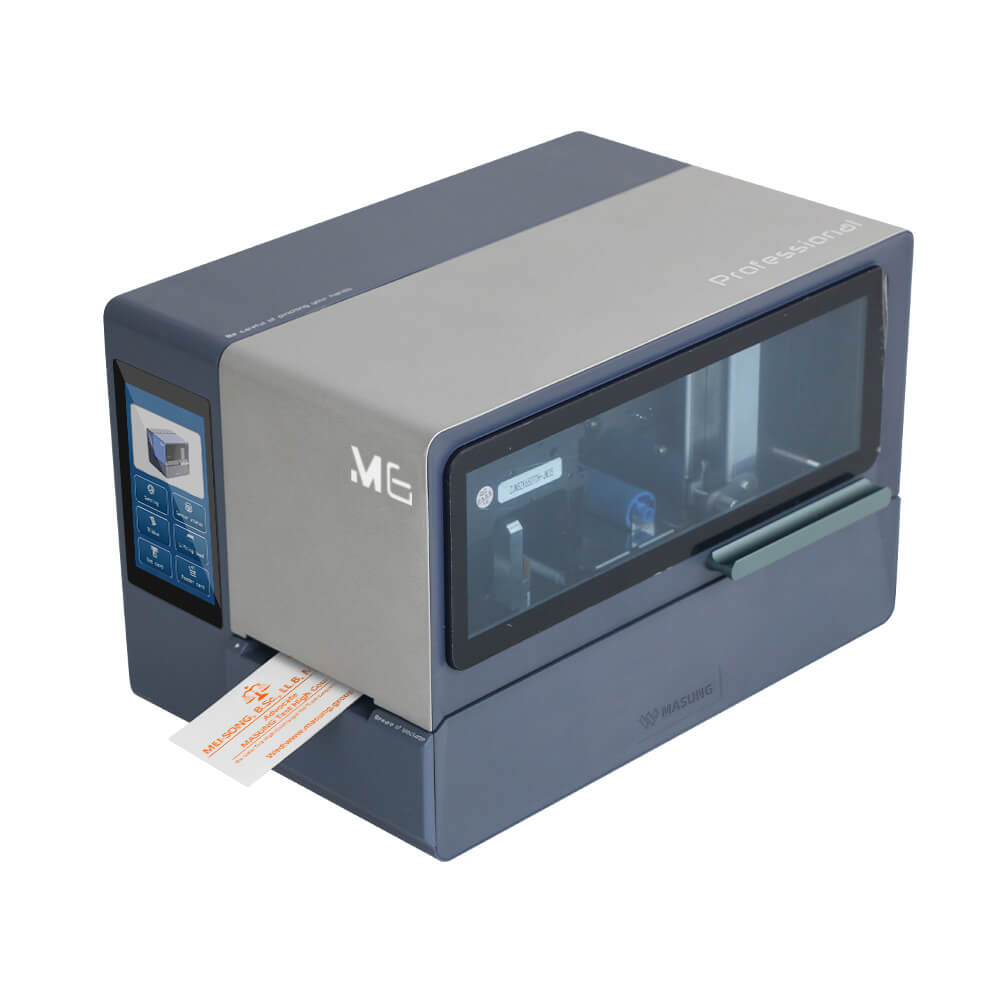
For businesses producing customised industrial identification plates, the ability to move from design to finished nameplate quickly can make digital metal printing a practical addition to the production workflow. As a professional metal nameplate printer manufacturer, Masung has recently launched the MS-ZK650-M6 Customizable Printer for Printing Aluminium Nameplates & Business Cards for your ideal choice as it features:
It features:
Customisable Aluminium Nameplate Printing – Designed for printing customised aluminium nameplates, name cards, business cards, industrial equipment labels, and compatible perforated metal cards.
300 DPI Thermal Transfer Printing – Uses monochrome thermal transfer technology to deliver clear, precise text, logos, and identification information at up to 300 DPI and 50 mm/s.
Flexible Printing Parameters – Masung-developed software allows users to adjust print content, print concentration, and print head pressure for different customised printing requirements.
Supports Various Aluminium Card Sizes – Handles 0.7–0.9 mm thick aluminium plates, with card lengths of 50–86 mm and widths of 35–54 mm, supporting up to 100 sheets of 0.9 mm cards.
Dedicated Resin Ribbon System – Uses a 650 Series ribbon cartridge with a 60 mm × 100 m resin-based ribbon and NFC ribbon identification for efficient printing management.
Compact & Flexible Connectivity – Measuring 310 × 210 × 215 mm and weighing 10.25 kg, the printer supports standard USB connectivity for Windows, with optional Bluetooth communication for Android devices.

